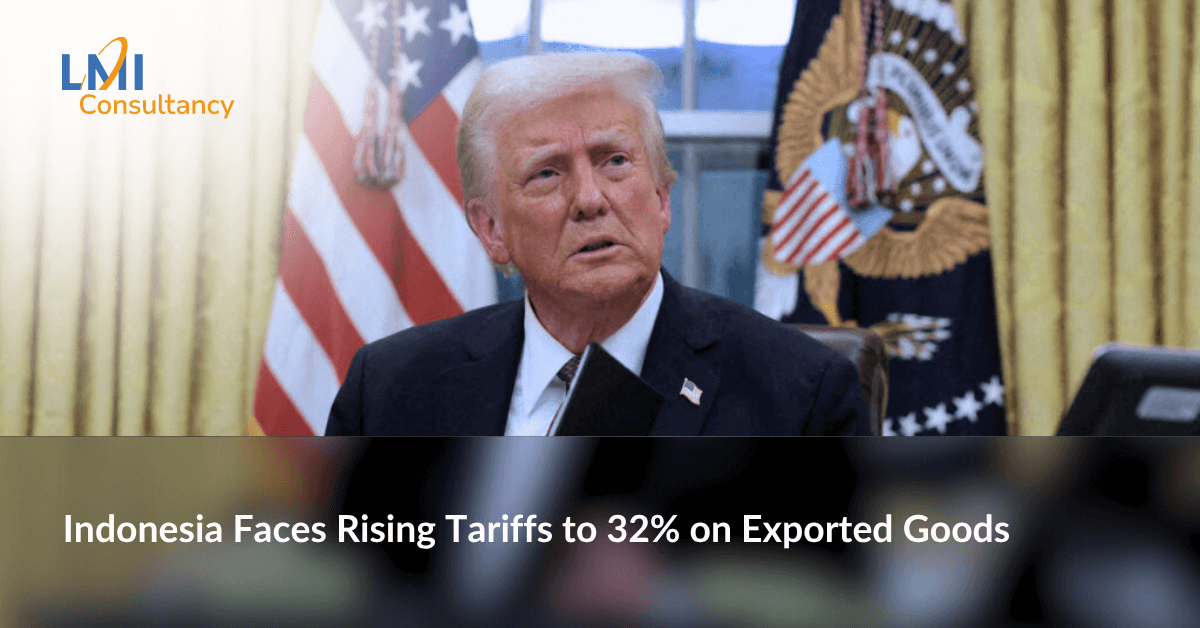
President Donald Trump announced a 32% tariff on all Indonesian goods imported into the U.S., effective 1st of August, 2025.
With just weeks remaining before a steep 32% tariff on Indonesian goods takes effect, Indonesia is grappling with how to respond to an increasingly transactional U.S. trade policy led by former President Donald J. Trump. The tariff, originally announced in April and now scheduled to begin on 1 August 2025, underscores deepening tensions between Washington and Jakarta, even as Indonesia had tried to placate the U.S. with billions in trade and investment commitments.
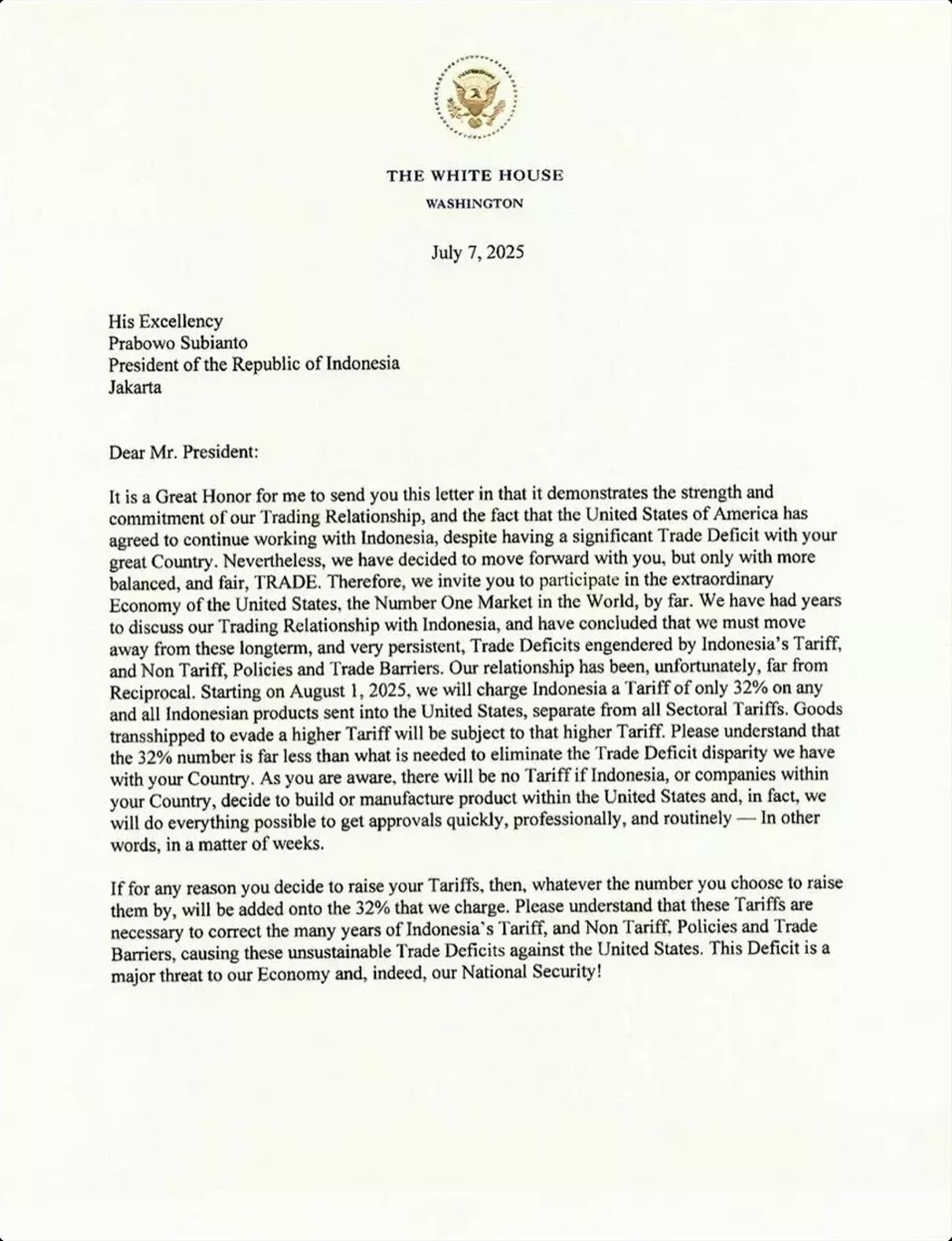
The announcement was made via President Trump’s social media platform, Truth Social, on Monday, accompanied by a series of letters to leaders of key trading partners, including Indonesian President Prabowo Subianto. In his message to Mr. Prabowo, Mr. Trump wrote that the tariffs would apply “on any Indonesian products” unless Indonesia agreed to increase investment within the United States.
“Please understand that the 32% number is far less than what is needed to eliminate the trade deficit disparity we have with your country,” Mr. Trump wrote. “These tariffs may be modified, upward or downward, depending on our relationship with your country.”
The new tariff, separate from sector-specific duties and on top of an existing 10 % baseline tariff, comes as a surprise to Indonesian officials, who believed they had made significant progress in trade discussions. Jakarta’s efforts included a recently announced $34 billion memorandum of understanding (MoU) with American companies, which covered increased U.S. imports of agricultural products, energy, and Boeing aircraft, and included investment deals through Indonesia’s sovereign wealth fund, Danantara.
“It’s a surprise,” Airlangga Hartarto, Indonesia’s Coordinating Minister for Economic Affairs, said in an interview en route to Washington. “We have been moving 180 degrees, and the U.S. is not moving at all. There were a lot of things we had already discussed in detail.”
The proposed MoU, signed on July 7, was intended to offer a clear path to narrowing the trade gap, a priority repeatedly emphasised by Mr. Trump. Yet, so far, Washington appears unmoved.
In contrast, the U.S. has announced tariff reductions for other Southeast Asian nations. Vietnam, for instance, will see tariffs drop to 20% from 46%, while Cambodia’s rate will fall to 36% from 49%. Indonesia, despite being the fourth most populous nation and a major U.S. trading partner, remains subject to the full 32% rate.
Recent US Economic Policy
Trade analysts and former diplomats see the tariff not as an economic response, but as a political strategy. They suggest Indonesia may have underestimated the extent to which Mr. Trump’s trade policies are shaped more by optics and domestic narratives than by traditional metrics of reciprocity or fairness.
“This outcome was avoidable,” said Iman Pambagyo, a former Indonesian ambassador to the World Trade Organization. “Some of us warned early on that playing Trump’s game would be a trap. Now that the trap has sprung, the question is not how to appease Washington further, but how to build genuine resilience.”
Other regional economists argue that Jakarta should avoid engaging with the Trump administration directly and instead influence Washington through its powerful corporate stakeholders.
“Trump will not listen to Indonesia, ASEAN, or any other country,” said Lili Yan Ing, Secretary General of the International Economic Association. “To safeguard its interests, ASEAN must work through U.S. companies that have reaped trillions of dollars from the region. These firms are ASEAN’s most effective channel to ensure its voice is heard.”
Also read: Do You Need A Business Consulting in Indonesia?
Indonesia’s Membership in BRICS
Indonesia’s recent entry into BRICS, a bloc that includes China, Russia, Brazil, and South Africa, may have further complicated matters. Mr. Trump has openly criticised BRICS as promoting “anti-American policies” and has signalled that countries aligned with the group could face additional tariff hikes. He recently floated a 10 % increase on top of existing tariffs for any BRICS country perceived to undermine U.S. interests.
Though Indonesia’s membership in BRICS had long been in discussion as a strategic move to diversify global partnerships, it now places Jakarta in an awkward position, seeking economic independence and regional influence, while risking fallout from its largest non-Chinese export market.
What’s at Stake
The proposed tariff will apply broadly to Indonesian goods, regardless of sector, making it particularly damaging to industries ranging from textiles and rubber to electronics and consumer goods. Analysts say the fallout could be significant, affecting not only Indonesian exporters but also American firms with supply chains tied to the region.
Further, Mr. Trump’s administration has warned that any retaliatory tariffs imposed by Indonesia will be met with matching increases. Indonesia has not yet responded with a formal countermeasure, but officials are reportedly weighing both WTO legal action and diplomatic back channelling through U.S. private sector lobbies.
Trump, however, offered a possible path forward in his letter to Mr. Prabowo: invest in America. He emphasised that Indonesian companies would be exempt from tariffs if they chose to manufacture within U.S. borders, promising “quick, professional, and routine approvals, within weeks.”
With the August 1 deadline fast approaching, Indonesia faces a stark choice: ramp up direct investment in the United States or recalibrate its trade strategy entirely. For now, Airlangga Hartarto has dispatched teams to Washington in a final push to salvage negotiations.
But as experts warn, Trump’s unilateral approach and use of tariffs as a geopolitical tool may leave little room for compromise, unless Jakarta finds new allies not in governments, but in boardrooms.
“We are still open to discussion,” Airlangga said. “But we need to see whether discussion is truly possible.”
As the world watches, Indonesia’s next moves may determine whether this tariff standoff becomes a long-term rupture or just another storm in a volatile trade landscape.