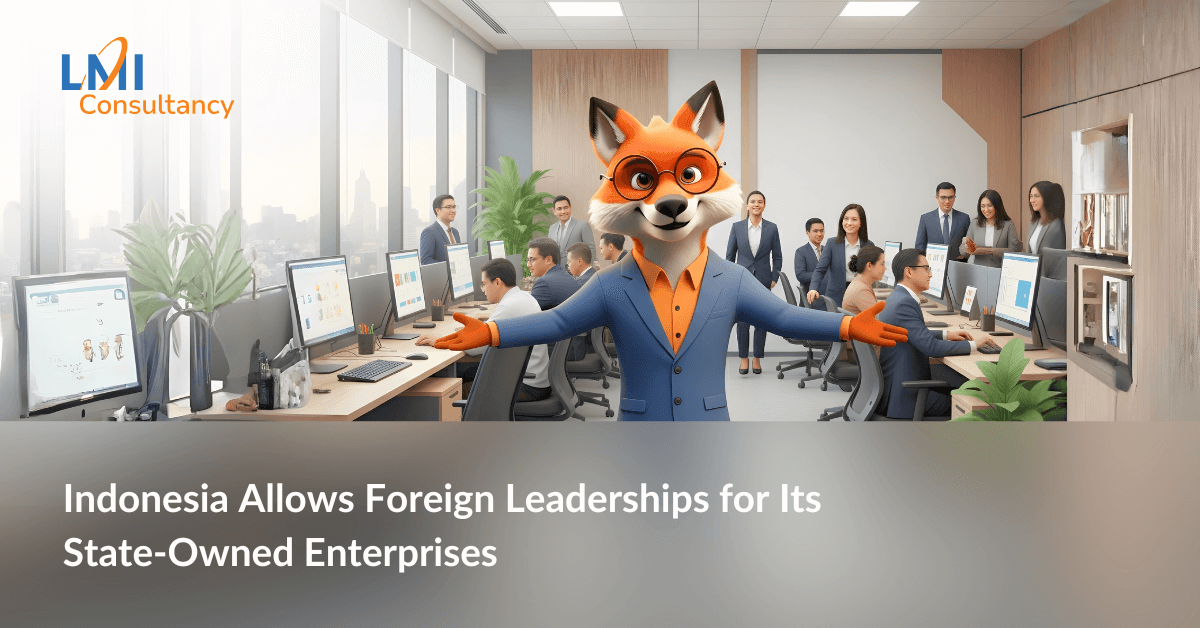
In a sweeping pivot in state enterprise governance, President Prabowo Subianto announced that foreign nationals (WNA) will now be eligible to lead Indonesia’s state-owned companies (BUMN), marking a bold shift in decades-old policy. The announcement came during a dialogue with Forbes Chairman Steve Forbes at the Forbes Global CEO Conference on 15 October 2025 in Jakarta, where Prabowo said:
“I’ve changed the rules. Now expatriates can lead our BUMN.”
The policy change accompanies a broader overhaul of the state sector. Prabowo has also instructed that the number of BUMNs be reduced dramatically, from around 1,000 to just 200–240 firms, under the newly formed Danantara Indonesia sovereign fund.
Foreign Leadership in BUMNs to Strategise Competitiveness
At the event, Prabowo framed the reform as integral to repositioning Indonesia’s state enterprises for global competitiveness. He stressed that BUMNs should adopt international business standards to boost efficiency and returns. “We must lift returns from one or two percent to higher levels,” he said, calling on corporate leadership to evolve accordingly.
Already, the shift is visible at Garuda Indonesia, Indonesia’s national airline. In a landmark Extraordinary Shareholders’ Meeting held the same day, two expatriate executives were appointed: Neil Raymond Mills as Director of Transformation, and Balagopal Kunduvara as Director of Finance & Risk Management. Their global experience is expected to accelerate Garuda’s turnaround.
While welcoming the change, stakeholders emphasise that Indonesian nationals (WNI) remain the primary candidates for strategic leadership roles in BUMNs. Pandu Sjahrir, Chief Investment Officer at Danantara, said WNI will still be prioritised, while WNA may fill roles only when exceptional talent is needed. “We look first to the best of Indonesia, the diaspora, then to foreigners,” he said.
The shift is not without obligations. Indonesia’s anti-corruption body (KPK) clarified that foreign directors appointed to BUMNs will be subject to the same asset-reporting (LHKPN) requirements as Indonesian officials, and can face prosecution if involved in corruption. “BUMN executives are public officials by law, regardless of nationality,” said spokesperson Budi Prasetyo.
What It Means for Investors, Corporations & Governance
This policy pivot opens new pathways for foreign talent to lead major Indonesian enterprises, raising both opportunity and complexity. Companies seeking to engage with BUMNs or bid on strategic state projects must now consider:
- Compliance readiness: WNA in executive roles will face rigorous scrutiny, including asset declarations and audits.
- Governance expectations: Foreign executives will be judged by international benchmarks, but must also navigate Indonesia’s political, social, and regulatory nuances.
- Talent sourcing strategy: BUMNs and state-holding companies will increasingly compete globally to attract top-level executives, making local and foreign recruitment strategies more sophisticated.
- Operational pressure: The downsizing of the BUMN roster places pressure on selected entities to perform efficiently and profitably — failure may risk further consolidation or restructuring.
For foreign and domestic companies alike, the message is clear: this is no longer a domestic elite’s playground. Strategic alignment, compliance discipline, and cross-border leadership will be critical to operating alongside BUMNs in this new era.
Staying Updated & Compliant with LMI Consultancy
As Indonesia makes such foundational changes, the regulatory environment is shifting rapidly. At LMI Consultancy, we are monitoring developments closely and advising clients accordingly. Whether you are a foreign investor, a corporation aiming to partner with BUMNs, or an executive eyeing a BUMN leadership role, here’s how we can help:
- Regulatory intelligence: We issue up-to-date briefings as BUMN law, LHKPN rules, and investment policies evolve.
- Governance advisory: We guide foreign executives on compliance, reporting, and adaptation to Indonesia’s governance expectations.
- Partner matching: We assist in navigating joint ventures, strategic partnerships, and BUMN procurement processes.
- Operational readiness: From licensing to tax compliance, our team ensures your structure is robust enough to engage meaningfully in Indonesia’s state-led ecosystem.
In this dynamic period of reform, Indonesian businesses and inbound investors must remain agile and fully compliant. When rules change, having a local partner who understands both Indonesian law and global standards is essential.