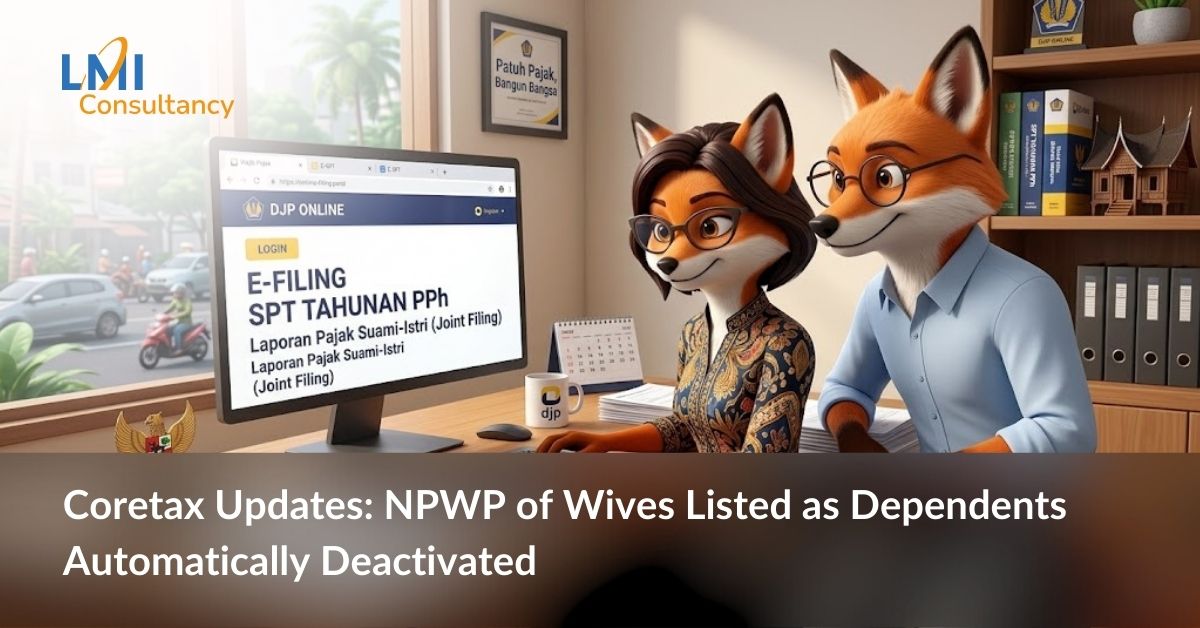
If you or a family member files taxes in Indonesia, a recent administrative change in the Directorate General of Taxes (DJP) Coretax system may affect you. From 25 January 2026, the tax authority implemented an automatic deactivation of certain NPWP of wives (Taxpayer Identification Numbers) recorded as dependents in their husband’s family profile (Data Unit Keluarga, DUK).
Key Highlights
- Indonesia’s Directorate General of Taxes (DJP) has introduced an automatic administrative update through the Coretax system, deactivating NPWP numbers belonging to wives who are registered as dependents in their husband’s Data Unit Keluarga (DUK) profile.
- The change applies to married women whose NPWP is recorded under their husband’s family tax profile and who do not report taxes separately. The update is administrative in nature and was applied automatically within the system.
- Even if the wife’s NPWP becomes inactive, the household’s tax obligations still apply. Under the consolidated reporting structure, the husband becomes the primary taxpayer, and all household income, including the wife’s income, must be declared in the annual tax return (SPT Tahunan) under the husband’s NPWP.
Q: What exactly changed in Coretax?
The DJP updated Coretax to reflect family-based tax administration more consistently. When a wife is recorded as a dependent in the husband’s DUK profile, and the couple’s tax affairs are administratively consolidated, Coretax automatically switches the wife’s NPWP to non-active status. The change was implemented centrally and required no action from taxpayers to take effect.
Q: Who is affected by the deactivation?
Married women whose NPWP is registered as a dependent within their husband’s DUK entry and who do not file separately are the primary group affected.
The policy applies to records present in Coretax as of the implementation date; it does not target individuals for enforcement or penalties, and it is an administrative consolidation.
Q: Does deactivation cancel tax obligations?
No. Deactivation is an administrative measure; it does not eliminate tax liabilities. Households whose wives’ NPW are set to non-active remain responsible for reporting and paying income tax.
Under the consolidated approach, the husband (as head of household) becomes the principal filer: the household’s income should be reported through his NPWP and included in his annual tax return (SPT Tahunan).
Q: Why did the DJP introduce this measure?
The DJP has cited several administrative objectives: simplify family tax administration, reduce duplicate taxpayer records, align the database with the legal concept of the family as a single economic unit, and improve monitoring and compliance through a cleaner, integrated dataset in Coretax.
Q: What is the legal basis for the change?
The policy is consistent with existing tax law principles. Relevant provisions include Article 8 of the Income Tax Law (UU Pajak Penghasilan), which contemplates family taxation in certain circumstances, and Article 5 paragraph (1) of PER-7/PJ/2025, which addresses the merger of rights and obligations when spouses do not manage tax liabilities separately. These regulations provide the authority for consolidating family tax records in an integrated system.
Q: Can a wife still file taxes separately if she wants to?
Yes. The regulation preserves options for separate filing. A married woman may retain an active NPWP and file independently if she chooses one of the recognised statuses: Memilih Terpisah (MT), choosing to report separately; or Pisah Harta (PH), separation of assets.
These statuses must be declared and recorded correctly in Coretax and in the household’s DUK record.
Q: How do I reactivate an NPWP that has been set to non-active?
Reactivation requires updating Coretax and DUK records. In practice, the steps are:
- The wife logs into Coretax and updates her taxpayer profile to indicate MT or PH status.
- The husband amends the household record in DUK to change the wife’s status to “Head of Another Family Unit (MT/PH)”.
- After synchronization of DUK and Coretax data, the wife submits a request to reactivate the NPWP through the Coretax portal.
Once verified, the NPWP status can be restored, and the wife may file her own annual return again.
Q: What documents are typically needed to support reactivation or separate filing?
Evidence depends on the chosen route (MT or PH) but commonly includes identity documents, a marriage certificate, a written declaration of separate filing or separation of assets, employer payroll records (if applicable), and any legal documents underpinning asset separation.
Employers may also require active NPWP records for payroll withholding and reporting, so coordination between the employee and employer is often necessary.
Q: What should expatriates and foreign residents know?
Expatriate families should note that similar administrative consolidation can apply if their household is recorded in Coretax as a single economic unit.
Employers often require an active NPWP for payroll and withholding. Expatriates should confirm whether they or their spouse is registered as dependents, review residency and tax residency rules, and ensure payroll and reporting align with Indonesian requirements.
Q: What practical steps should taxpayers take now?
We recommend the following:
- Check your Coretax profile and DUK family record to see whether your NPWP has been deactivated.
- Review whether joint or separate filing best suits your situation, particularly if you have independent employment income or specific contractual obligations.
- If you need a separate NPWP, prepare documentation to support MT/PH status and follow the reactivation steps in Coretax.
- Consult your employer’s HR or payroll team to confirm how household consolidation affects withholding and reporting.
Q: How can LMI Consultancy help with your Annual Tax Reporting?
Indonesia’s move to consolidate family tax records through Coretax is part of a broader digitalisation effort. For many households, the change simplifies reporting.
For professionals, expatriates, and families with separate income streams, the update underlines the importance of reviewing registration status and choosing the filing approach that best fits legal and practical needs.
LMI Consultancy provides practical, end-to-end tax support for individuals and families navigating Coretax. Our team assists clients with:
- Tax registration and compliance
- NPWP and Coretax administration
- Personal and corporate tax reporting
- Immigration and business advisory services
Report Your Spousal Tax in Indonesia with LMI Consultancy
If your wife’s NPWP has been deactivated and you need to report your SPT or reactivate a taxpayer record, contact LMI Consultancy for a consultation.
Our tax consultants have experience across Coretax administration, expatriate payroll issues, and corporate compliance. We handle the administrative tasks so you can focus on work and family.
Report your SPT with LMI Consultancy for professional, compliant, and timely annual filing. Contact Ours Professional Consultant now for a Free Consultation.