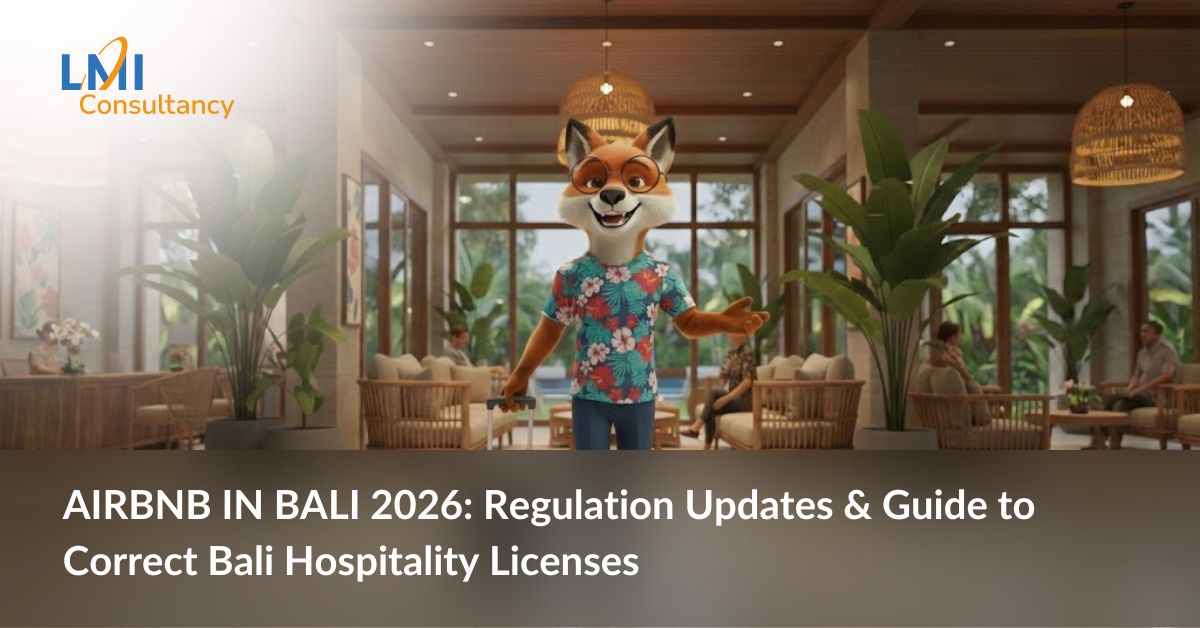
The Indonesian government has now clarified recent discussions regarding a possible restriction on Airbnb operations in Bali.
The Ministry of Tourism has confirmed that online booking platforms, such as Airbnb and Booking.com, will not be banned.
Instead, the focus is shifting toward strict regulatory compliance, proper licensing and permit enforcement, as well as tax registration ahead of a firm deadline in 2026.
For property owners, villa operators, and foreign investors, this should mark a critical point of attention.
Key Highlights
- Bali initially proposed halting Airbnb-style accommodations due to lost regional tax revenue (PAD).
- The central government has clarified that platforms such as Airbnb and Booking.com will not be banned.
- The enforcement focus is on illegal and unlicensed properties.
- All short-term rental listings must comply with Indonesian regulations by 31 March 2026.
- Non-compliant properties risk removal from booking platforms.
- Short-term rentals are legally classified as accommodation businesses, not simple property ownership.
- Operators must comply with KBLI classification, licensing, and PHR (Hotel & Restaurant Tax) obligations.
Why Bali Raised Concerns in the First Place
In late 2025, Governor Wayan Koster announced plans to review and potentially halt Airbnb-style accommodations. The core issue was not tourism itself; Bali’s visitor numbers remain strong, but regional tax revenue.
Despite rising tourist arrivals, hotel occupancy rates, particularly among members of Perhimpunan Hotel dan Restoran Indonesia (PHRI) Bali, have not reflected similar growth.
That time, the authorities argued that:
- Thousands of villas and private homes operate without proper licences.
- Many do not register or pay the Hotel & Restaurant Tax (PHR).
- Over 2,000 accommodations in Bali are reportedly unlicensed.
- Tax avoidance creates unfair competition for compliant hotels.
This concern centers on lost Pendapatan Asli Daerah (PAD), records said, and the need for a level playing field within Bali’s tourism ecosystem.
Also read: Bali Proposed to Ban Airbnb
Updated Government’s Clarification: NO Platform Ban
However, recent statements from the Ministry of Tourism confirm:
- Platforms such as Airbnb and Booking.com will not be prohibited.
- Tourists will continue to book short-term rentals.
- The regulatory target is non-compliant operators, not digital platforms.
The Reality: Licensed Hotels vs Online Listings
Official data still shows that only a few hundred hotels in Bali hold complete accommodation licences. In contrast, thousands of villas, guesthouses, and apartments are actively listed on short-term rental platforms.
A substantial number of these listings have been operating without full licensing compliance and fall within a regulatory grey area.
Therefore, to address this issue, the central government set a firm compliance deadline:
By 31 March 2026, all accommodation listed on online platforms must comply with Indonesian licensing and tax regulations.
Non-compliant listings would risk removal from Airbnb, Booking.com, and other booking platforms.
Disclaimer:
- Tourists will still be able to book properties.
- However, property owners operating without a proper legal structure face increasing regulatory risk.
For foreign nationals entering Bali’s property and hospitality sector, understanding and properly managing the legal requirements for short-term rental operations is essential to ensuring full regulatory compliance and long-term business sustainability.
Legal Requirements for Short-Term Rental Operations in Bali
Establishing a company and registering a listing on platforms such as Airbnb is not, in itself, sufficient to legally operate a short-term rental business in Bali.
At a minimum, a company must hold foundational corporate documents, including:
- Deed of Establishment
- Ministry of Law and Human Rights Approval (SK)
- Business Identification Number (NIB) issued through the OSS system
However, once a property is offered for daily or short-term rental, the activity is no longer regarded as passive property ownership. Under Indonesian law, it is classified as an accommodation business activity, which triggers additional licensing and tax obligations.
Depending on the property’s classification and operational model, the following may be required:
- Appropriate accommodation-related KBLI classification
- Standard Certificate (Sertifikat Standar)
- PBG (Persetujuan Bangunan Gedung / Building Approval)
- SLF (Sertifikat Laik Fungsi / Certificate of Feasibility)
- Registration for Hotel & Restaurant Tax (PHR)
Each property must be assessed individually. There is no universal “Airbnb licence” applicable to all cases.
PT PMA vs PT PMDN: Selecting the Appropriate Structure
The choice between a foreign-owned company (PT PMA) and a locally owned company (PT PMDN) is a critical compliance consideration.
Foreign investors operating through a PT PMA must carefully review regulatory restrictions, particularly where the property is legally classified as residential. A residential property cannot automatically be rented on a daily basis without the appropriate accommodation licence and relevant KBLI classification.
Short-term rental operations must align with accommodation-related KBLI codes and applicable licensing requirements.
Indonesian-owned companies (PT PMDN) may have broader flexibility, as they are not subject to foreign investment limitations under Indonesia’s investment framework. Nevertheless, compliance remains mandatory.
The appropriate structure depends on several factors, including:
- Property zoning and classification
- Business model and operational scope
- Local Bali regulatory policies
- Ownership composition (PMA or PMDN)
Careful legal structuring is essential to avoid future regulatory exposure.
Hotel & Restaurant Tax (PHR) – 10%
Most short-term rental accommodations in Bali are subject to Hotel & Restaurant Tax (PHR), currently set at 10%.
Key compliance points include:
- PHR is administered by the local government
- Operators must register and obtain a regional taxpayer number (NPWPD)
- Monthly tax reporting and payment are mandatory
- Booking platforms do not collect or remit PHR on behalf of operators
- Platform commissions do not replace tax obligations
The responsibility for compliance remains entirely with the operator. Failure to register and report properly may result in administrative sanctions or listing removal.
Preparing for the 31 March 2026 Compliance Deadline
With enforcement tightening ahead of the national compliance deadline, property owners and investors should take proactive steps to mitigate regulatory risk.
Recommended actions include:
- Reviewing the current company structure (PT PMA or PT PMDN)
- Ensuring the correct accommodation-related KBLI classification
- Verifying the validity of PBG and SLF documentation
- Registering for PHR and confirming reporting procedures
- Aligning actual operational activities with the licensed business scope
Early preparation significantly reduces the risk of administrative penalties or platform delisting.
How LMI Consultancy Can Assist
Company registration alone does not automatically legalise short-term rental operations in Bali. The company structure, business classification, licensing documentation, and tax registration must be properly aligned with Indonesian regulations.
LMI Consultancy provides comprehensive advisory services to investors, property owners, and hospitality operators seeking a compliant and sustainable business framework.
Our services include:
- Advisory on selecting the appropriate legal structure (PT PMA, PT PMDN, or management arrangement)
- Determination of the correct KBLI classification based on operational activities
- Assistance with OSS registration, NIB issuance, and required licences (Standard Certificate, PBG, SLF)
- Registration support for Hotel & Restaurant Tax (PHR)
- Compliance reviews aligned with current and upcoming regulations
- Risk mitigation advisory to prevent administrative sanctions and listing removal
Our objective is to ensure that your short-term rental business operates legally, securely, and efficiently within Indonesia’s regulatory framework.
For tailored guidance and a structured compliance review, Contact LMI Consultancy to establish a reliable and fully compliant business structure in Bali.