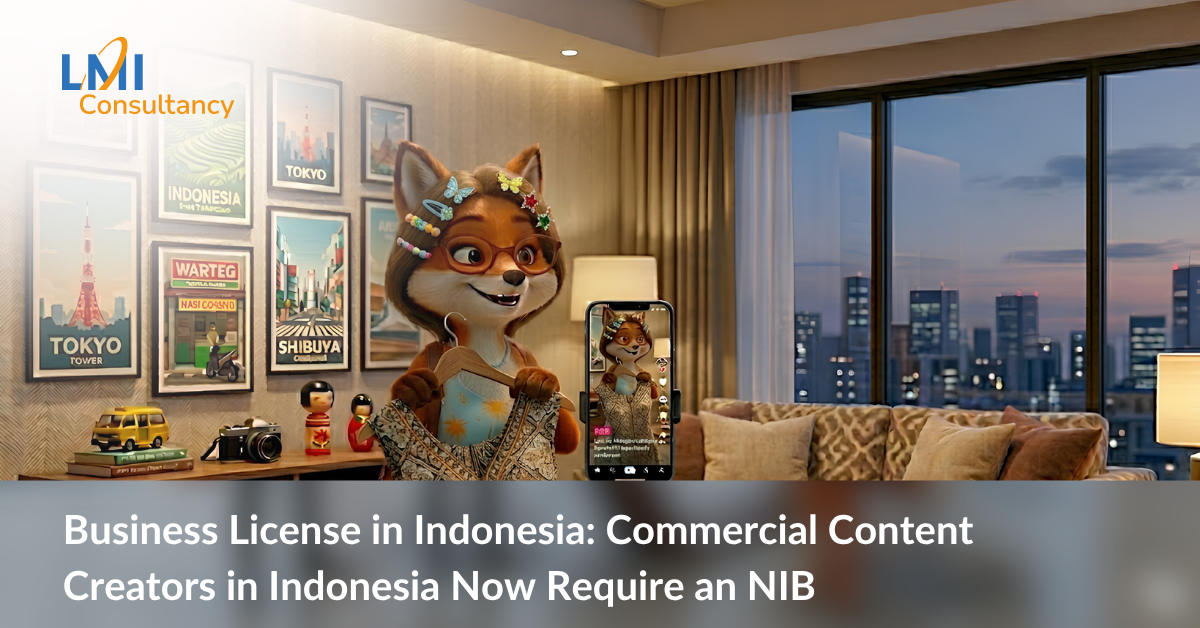
As content creation evolves from a creative hobby into a professional business, the government now formally recognises commercially active content creators as business operators under Indonesia’s licensing framework by registering a Business License (NIB).
Following the implementation of KBLI 2025 (Indonesian Standard Industrial Classification) and Minister of Trade Regulation (Permendag) No. 19 of 2026, creators who earn income through digital content are now required to obtain a Business Identification Number (Nomor Induk Berusaha or NIB). The requirement officially took effect on 18 June 2026 and forms part of Indonesia’s broader effort to improve legal certainty, strengthen regulatory oversight, and support a more structured digital business ecosystem.
Which Content Creators Must Register for an NIB?
The regulation does not apply to every individual with a social media account.
An NIB is generally required only when content creation is conducted as a commercial activity or generates income on a regular basis. Once a creator begins operating as a business, they may be required to formalise their activities through business registration.
Commercial creators commonly include those who:
- Receive income from brand endorsements or paid collaborations;
- Earn advertising revenue through platforms such as YouTube or TikTok;
- Produce sponsored or commissioned content for clients;
- Offer influencer, talent management, or audiovisual production services; or
- Generate recurring income through social media monetisation.
Individuals who create content solely for personal expression without commercial gain are generally not required to register for an NIB.
Understanding the Role of an NIB for Business in Indonesia
An NIB (Nomor Induk Berusaha) serves as the official business identity issued through Indonesia’s Online Single Submission (OSS) system.
Consisting of a unique 13-digit number, the NIB functions as a business’s primary registration number while consolidating important information such as:
- Business identity and profile
- Tax Identification Number (NPWP)
- Business classification (KBLI)
- Capital information
- Registered business address
Beyond serving as proof of registration, the NIB may also function as an import identification number, customs access registration, social security enrolment record, and initial manpower reporting document where applicable.
Once issued, the NIB remains valid throughout the life of the business, provided the business continues to comply with prevailing regulations.
Types of Business Licenses Depends on Your Risk Classification (RBA Licensing System)
Indonesia now applies a Risk-Based Business Licensing system, meaning licensing requirements differ according to the nature and level of risk associated with a business activity.
For digital creators, the applicable licensing requirements may fall into one of four categories:
Low Risk-Based
Only an NIB is required to legally operate.
Low-Medium Risk
Businesses must obtain an NIB together with a Standard Certificate through self-declaration.
High-Medium Risk
Businesses require an NIB and a government-verified Standard Certificate before commencing operations.
High Risk
Businesses must secure an NIB alongside the relevant operational licences prior to conducting commercial activities.
The applicable category depends on the selected KBLI classification and the creator’s business model.
Administrative Sanctions for Non-Compliance
The government has introduced a progressive enforcement framework for businesses that fail to obtain the necessary business licences.
Depending on the severity of the violation, authorities may impose:
- Written warnings;
- Temporary suspension of business operations;
- Administrative fines;
- Restrictions on commercial activities;
- Revocation of business licences or certifications; and
- Permanent cancellation of the NIB.
Rather than immediate punitive action, the framework is designed to encourage compliance while maintaining proportionality.
Digital Platforms Will Also Play a Supervisory Role
The latest regulations also extend responsibilities to marketplace operators and commercial digital platforms.
E-commerce providers and commercial social media platforms are expected to verify the legal status of business users operating on their platforms. Creators who fail to complete the required registration after the applicable transition period may face platform-level restrictions.
Possible consequences include:
- Temporary legalisation notices on business accounts;
- Suspension of shopping or transaction features;
- Removal of monetisation facilities; and
- Permanent deactivation of commercial accounts.
The objective is to improve accountability across Indonesia’s digital commerce ecosystem while providing greater protection for consumers.
Legal Registration Unlocks Government Support
Beyond regulatory compliance, obtaining an NIB also provides access to a range of government programmes designed to support entrepreneurs and small businesses.
Registered business owners may become eligible for financing initiatives, entrepreneurship training, business incubation programmes, halal certification assistance, and intellectual property support, subject to the applicable requirements.
Without an NIB, commercially active creators may miss opportunities to access these government-backed initiatives.
Business License in Indonesia According to KBLI
Indonesia adopts a risk-based business licensing system, meaning that the type of business license Indonesia requires will vary depending on the company’s selected KBLI (Klasifikasi Baku Lapangan Usaha Indonesia) code and the level of risk associated with its business activities (usaha).
Depending on the business activity, a company may only require a Business Identification Number (NIB), while others may also need a Standard Certificate, verified certification, or a sector-specific operational permit before commencing commercial operations.
Business Licensing for PT PMA
A PT PMA (Foreign-Owned Limited Liability Company) is a legal entity established under Indonesian law that allows foreign investors to conduct business activities in Indonesia. After the company is incorporated, it must obtain the appropriate business licences before beginning operations.
The required licences vary depending on the company’s KBLI classification and risk level. Under Indonesia’s OSS RBA framework, a PT PMA may be required to obtain:
- Business Identification Number (NIB) for low-risk business activities;
- NIB and Standard Certificate for low-medium risk businesses;
- NIB and Government-verified Standard Certificate for medium-high risk sectors; or
- NIB and a sector-specific business permit or licence for high-risk industries.
Certain industries may also require additional technical approval from the relevant ministry or regulatory authority before the business can legally operate.
Register Your NIB with LMI Consultancy
As Indonesia continues to formalise its digital economy, obtaining an NIB is becoming an essential step for content creators, influencers, freelancers, and other digital entrepreneurs operating commercially.
At LMI Consultancy, we provide comprehensive assistance with NIB registration, OSS applications, KBLI selection, and business licensing compliance. Our experienced consultants help simplify the registration process, ensuring your business activities are aligned with Indonesia’s latest regulatory requirements while allowing you to focus on building your digital brand.
Whether you are launching your career as a professional content creator or expanding an existing digital business, LMI Consultancy is ready to guide you through every stage of the registration process. Contact our team today to register your NIB efficiently and operate your business with confidence under Indonesia’s evolving regulatory framework.