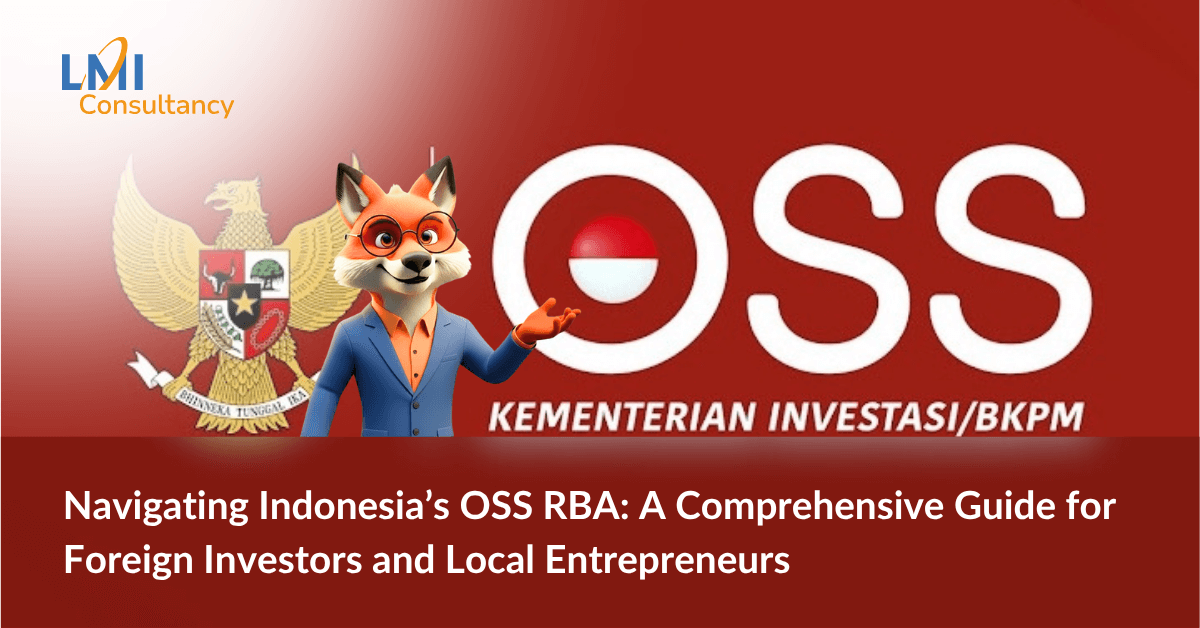
Indonesia’s effort to streamline investment and business licensing has taken shape through the OSS RBA (Online Single Submission Risk-Based Approach), a digital platform designed to simplify the country’s notoriously complex regulatory environment.
For foreign investors and local business owners, understanding the system then becomes a base prerequisite to starting or expanding operations in Southeast Asia’s largest economy.
What is OSS System in Indonesia?
The OSS (Online Single Submission) licensing system (sistem perizinan berusaha) in Indonesia is a government-run digital platform that centralises and simplifies the process of applying for business licenses. Introduced under Government Regulation No. 24 of 2018 and later refined into the OSS RBA (Risk-Based Approach) through Government Regulation No. 5 of 2021, it was designed to cut through Indonesia’s complex bureaucracy and provide investors with a single access point to obtain permits and registrations.
Businesses can use the platform to secure a Business Identification Number (Nomor Induk Berusaha / NIB), which acts as the core identity for operating legally in Indonesia.
Understanding Risk-Based Approach: Why OSS RBA Matters
Introduced under Government Regulation (Peraturan Pemerintah nomor 5 Tahun 2021) on Risk-Based Business Licensing, OSS RBA (Onilne Single Submission Risk Based Approach) replaced the older OSS 1.1 system. It is designed to cut red tape, centralise licensing under one platform, and align Indonesia with international standards for investment ease.
For entrepreneurs, the system promises faster approvals and reduced bottlenecks. For foreign investors, it offers clarity: whether you are establishing a PT PMA (foreign-owned company) or partnering locally, the risk-based model ensures that the depth of licensing requirements matches the profile of your business activity.
In practice, this means a small-scale, low-risk operation may need nothing more than a Business Identification Number (NIB), while large or environmentally sensitive projects require layered approvals, from environmental permits to operational licenses.
What is the Online Single Submission Risk-Based Approach and How It Works
The OSS-RBA (Penyelenggaraan Perizinan Berusaha Berbasis Risiko) integrates multiple government agencies into a single electronic gateway, including the Ministry of Law and Human Rights (for deed registration) and the Directorate General of Taxes (for tax compliance verification).
The licensing structure operates on a tiered risk level, which involves Small Businesses (UMKM) to Multinational level businesses:
Low: Businesses require only an NIB, which also doubles as import identification, customs access, and registration for mandatory social security (BPJS).
Medium to medium-high: An NIB plus standard certifications and compliance checks are required. These include sectoral permits or technical verifications, depending on the business field.
High: Alongside an NIB, companies must secure full operational licenses and environmental assessments (such as AMDAL or UKL-UPL) before commencing activities.
For both locals and foreigners, the OSS system also serves as a direct channel to secure location permits, building approvals (IMB), and environmental approvals, all of which are essential for compliance.
Regulatory Requirements Investors Should Note
To ensure smooth registration, companies must align their founding documents and operations with Indonesia’s legal framework:
- KBLI 2020 alignment: Articles of association must state business activities consistent with Indonesia’s Standard Classification of Business Fields.
- Tax readiness: Company NPWP and up-to-date tax filings of directors or responsible persons.
- Legal documents: Company deed of establishment, Ministry approval (SK Menkumham), and domicile certificates.
- Location and environmental permits: Izin Lokasi, IMB, and, where necessary, environmental approvals such as AMDAL or UKL-UPL.
Foreign investors must also ensure their visa and work permit compliance aligns with the business setup to avoid complications.
Step by Step to Register to OSS RBA
Account Creation: Entrepreneurs register on the OSS-RBA platform. Indonesian citizens require a National Identity Number (NIK), while foreigners must use their passports. Both need an active email.
- Business Data Entry: The system collects information on business activity, sector classification, and investment value.
- NIB Issuance: Once the data is complete, an NIB is automatically generated, granting the company a legal identity.
- Verification: Depending on the business risk profile, additional approvals are triggered, ranging from automatic issuance for low-risk businesses to ministerial verification for high-risk fields.
- Monitoring & Compliance: For medium-high and high-risk categories, ministries or regional authorities conduct compliance checks and ongoing supervision.
- If applications are incomplete, the system returns them with a “needs correction” status, giving applicants the chance to provide missing information.
OSS Online Single Submission Risk Based Approach
Companies operating under Indonesia’s earlier OSS 1.1 licensing framework are now required to shift to the updated OSS-RBA system to stay compliant with the country’s risk-based licensing regime. The migration is not optional: businesses that fail to update their registrations risk being classified as operating without valid permits, exposing them to regulatory setbacks and legal complications.
For firms whose Business Identification Numbers remain inactive under the old system, the urgency is even greater. Without migration, companies may find themselves unable to file mandatory investment activity reports (LKPM) and could face enforcement actions from regulators, adding another layer of risk in an already complex operating environment.
Learn more about Migrating OSS to RBA with LMI Consultancy
Simplify Your OSS-RBA Transition: Why Partner with LMI Consultancy
While the OSS RBA system promises efficiency, in practice, navigating overlapping regulations and ensuring compliance with KBLI codes, tax rules, and environmental requirements can be daunting, especially for foreign investors unfamiliar with Indonesia’s bureaucracy. Our professional consultants will help coordinate with ministries for verifications and environmental approvals on your behalf.
At LMI Consultancy, we bridge this gap by ensuring your company’s documents align seamlessly with OSS-RBA requirements, managing the technical submissions through the official online submission platform, and advising on whether your business is classified as low, medium, or high risk-level, and what licenses that classification triggers.
By outsourcing the complexity to professionals, investors can focus on their core strategy while ensuring compliance and avoiding delays or costly missteps.