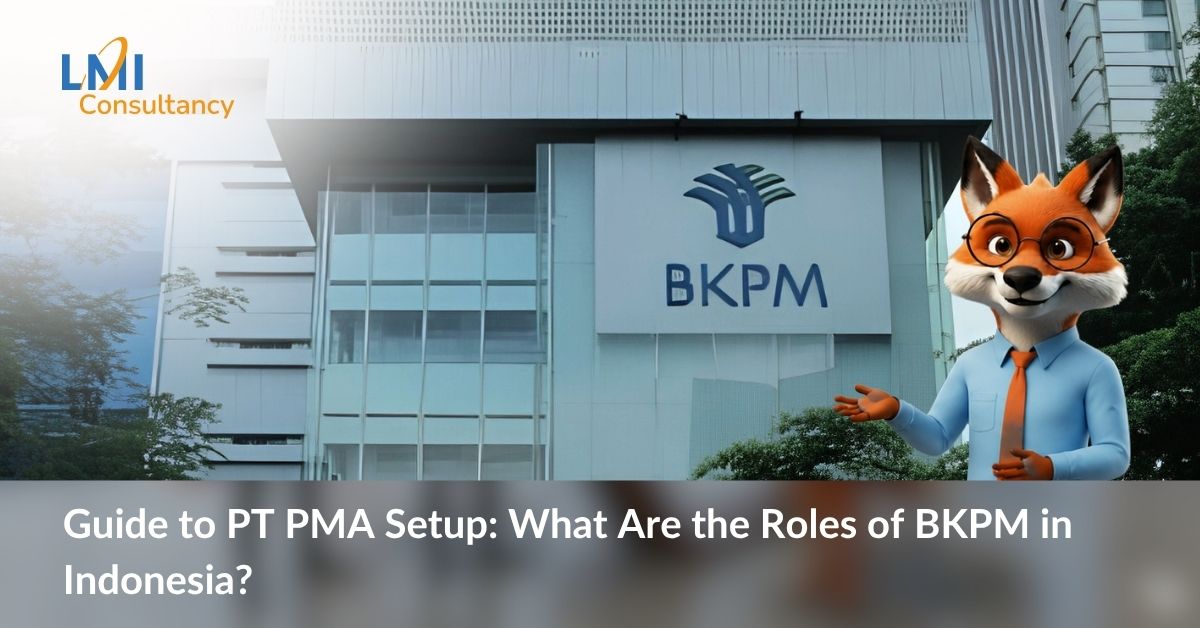
Establishing a foreign-owned company in Indonesia involves more than registering a business name. Foreign investors must understand the investment framework, select the appropriate business classifications, complete company registration and obtain the licences required for their planned activities.
The Badan Koordinasi Penanaman Modal (BKPM) plays a central role in Indonesia’s investment administration. Now operating within the Ministry of Investment and Downstream Industry (Kementerian Investasi dan Hilirisasi), BKPM is responsible for key investment policy, licensing coordination and investment activity monitoring functions.
For investors planning to establish a Perseroan Terbatas Penanaman Modal Asing (PT PMA) in 2026, understanding BKPM’s responsibilities can help clarify the registration process, capital requirements and ongoing compliance obligations.
LMI Consultancy explains how BKPM fits into PT PMA establishment, the role of the Online Single Submission Risk-Based Approach (OSS-RBA) system, and the importance of reporting investment activities through LKPM.
About BKPM in Indonesia
BKPM stands for Badan Koordinasi Penanaman Modal, commonly translated as Indonesia’s Investment Coordinating Board. It was established in 1973 to coordinate and facilitate domestic and foreign investment.
In April 2021, BKPM was elevated to ministerial status as the Ministry of Investment. Following the formation of President Prabowo Subianto’s administration in October 2024, the institution became known as the Ministry of Investment and Downstream Industry.
Although its institutional position has evolved, the BKPM name remains widely used in investment regulations and administrative processes. Its official website is bkpm.go.id.
For foreign investors, BKPM is particularly relevant when navigating investment policy, business licensing administration, investment reporting and coordination with other government authorities.
However, BKPM does not independently perform every step of company establishment. A PT PMA’s incorporation, licensing and subsequent operations involve several institutions, including the Ministry of Law, the OSS-RBA system and relevant sectoral authorities.
Who Is BKPM Relevant to in 2026?
BKPM’s functions are relevant to both domestic and foreign investors, particularly companies establishing or expanding investment projects in Indonesia.
For foreign investors, its investment framework affects decisions such as:
- Which business activities the proposed company may undertake.
- Whether foreign ownership is permitted and subject to restrictions.
- What investment and capital requirements apply.
- Which business licences and sector-specific approvals are necessary.
- How investment realisation must be reported after establishment.
Investors should assess these matters before committing capital or submitting incorporation documents. The applicable requirements depend on the business classification, investment structure, project location and sector regulations.
The Role of BKPM in PT PMA Registration
A PT PMA is an Indonesian limited liability company established for foreign investment. It is a separate legal entity from its foreign parent company and must comply with Indonesian corporate, investment, licensing and tax requirements.
BKPM plays an important role in the investment and business licensing framework, but PT PMA establishment requires coordination with other institutions.
1. Investment Planning and KBLI Selection
Before registering a PT PMA, investors should identify the business activities the company intends to conduct.
These activities must be matched to the appropriate Indonesian Standard Business Classification (Klasifikasi Baku Lapangan Usaha Indonesia, or KBLI). The selected classifications affect foreign ownership eligibility, licensing requirements and the approvals needed to operate.
Investors should review:
- The proposed business activities and corresponding KBLI codes.
- Applicable foreign investment restrictions.
- The required investment value and capital structure.
- The licences or technical approvals associated with each activity.
Selecting inappropriate KBLI codes can create complications during licensing or when the company begins operating. The company’s registered activities should reflect its actual business plans.
2. PT PMA Capital and Investment Requirements
Under BKPM Regulation No. 5 of 2025, the general minimum placed and paid-up capital for a PT PMA is IDR 2.5 billion, subject to applicable exceptions and other regulations.
This requirement should be distinguished from the general minimum investment threshold, which is more than IDR 10 billion per five-digit KBLI business field per project location, excluding land and buildings, subject to specific calculation rules and exceptions.
Investors should not treat paid-up capital and total planned investment as interchangeable figures. They serve different purposes in the company’s financial and investment planning.
The applicable capital placement, use and reporting requirements should be confirmed before funds are transferred or allocated to the Indonesian company.
3. Company Registration Through AHU
The Ministry of Law administers the legal entity registration system through the Directorate General of General Legal Administration, known as AHU.
For a conventional PT PMA, a licensed Indonesian notary prepares the deed of establishment and submits the relevant incorporation application through the applicable electronic system.
The process generally involves:
- Confirming the shareholder structure and proposed directors and commissioners.
- Preparing the deed of establishment and supporting corporate documents.
- Submitting the incorporation application through the relevant AHU system.
- Completing the applicable legal entity registration requirements.
- Proceeding with business identification and licensing through OSS-RBA.
A foreign parent company may need to provide incorporation records, constitutional documents, investment approvals and evidence of signatory authority. Authentication, legalisation and translation requirements should be confirmed with the notary.
Important distinction: AHU handles legal entity administration, while BKPM’s investment framework and OSS-RBA licensing processes address different parts of the company’s establishment and operational readiness.
4. Business Licensing Through OSS-RBA
The Online Single Submission Risk-Based Approach system is Indonesia’s central platform for business registration and risk-based licensing.
Through OSS-RBA, eligible businesses can obtain a Business Identification Number (Nomor Induk Berusaha, or NIB) and apply for the licences or approvals required for their activities.
The requirements depend on the risk classification of each business activity and the relevant sector regulations. Some activities may require additional verification, a Standard Certificate, an operational or commercial licence, or approval from a technical ministry or agency.
An NIB should not automatically be interpreted as permission to undertake every activity listed in a company’s business plan. Investors must confirm which additional requirements apply before commencing operations.
For companies entering regulated sectors, coordination with the relevant authority may be necessary in addition to the general registration process.
What Is LKPM, and Why Must Investors Pay Attention?
LKPM stands for Laporan Kegiatan Penanaman Modal, or Investment Activity Report. It is the reporting mechanism through which businesses report investment realisation and relevant operational information in accordance with applicable requirements.
LKPM is important because company establishment is not the end of an investor’s compliance obligations. Businesses may need to report their investment progress, expenditure, employment and other information according to the reporting rules applicable to their classification and circumstances.
LKPM Reporting Requirements
Investors should establish an internal process for collecting the information needed for LKPM submissions.
Depending on the company and applicable requirements, this may involve:
- Monitoring investment realisation against the investment plan.
- Maintaining supporting financial and operational records.
- Tracking relevant employment and business activity information.
- Identifying the applicable reporting schedule.
- Submitting reports through the designated system.
- Responding to requests or administrative follow-up from the relevant authority.
Failure to meet reporting obligations may result in administrative consequences under the applicable regulations.
The reporting frequency and requirements should be checked against the company’s current classification and regulatory position rather than assumed to be identical for every PT PMA.
What Services and Support Does BKPM Provide to Investors?
BKPM’s investment-related functions cover several areas that can affect foreign investors entering the Indonesian market.
Investment Information and Guidance
Investors can use official government resources to review investment policies, applicable regulations and information on Indonesia’s investment environment.
This information can help companies identify the regulatory framework relevant to their proposed projects, although individual eligibility and licensing requirements must still be assessed separately.
Licensing Coordination
BKPM’s investment administration framework and OSS-RBA support business registration and the processing of applicable licences.
Where an activity requires approval from another authority, the relevant technical ministry or agency may remain responsible for the sector-specific requirements.
Investment Monitoring
Through LKPM and related administrative mechanisms, the government monitors investment realisation and compliance with applicable reporting obligations.
Companies should therefore prepare for post-registration requirements when planning their investment, rather than focusing solely on incorporation.
Investment Incentive Coordination
Indonesia provides various investment incentives for eligible projects and sectors. These may include tax facilities, allowances or other fiscal benefits, depending on the applicable regulations.
Such incentives are not automatic. Eligibility, qualifying investment thresholds, application procedures and approval responsibilities vary by facility.
Investors should obtain current tax and investment advice before incorporating anticipated incentives into their financial projections.
Investment Incentives for Foreign Investors in Indonesia
Certain projects may qualify for investment-related fiscal facilities, depending on their sector, location, investment value and compliance with the relevant criteria.
Tax Holidays and Tax Allowances
Indonesia has established tax incentive frameworks for qualifying investments. The availability and extent of relief depend on the applicable regulations and the specific project.
Investors should verify the current qualifying sectors, thresholds, application process and competent approving authorities before relying on a tax holiday or tax allowance.
Incentives for Nusantara and Designated Regions
Certain investment facilities may also apply to projects in Nusantara, Indonesia’s planned new capital, and other designated areas.
Eligibility depends on the applicable policy, investment activity and project conditions. Businesses should obtain confirmation of the requirements before assuming that a location or investment structure qualifies.
LMI Consultancy can assist with tax consultation and business setup planning, while specific incentive eligibility should be assessed against the current rules and the investor’s circumstances.
How LMI Consultancy Can Help With PT PMA Setup
Establishing a PT PMA in Indonesia requires coordination across corporate registration, investment planning, business licensing and ongoing compliance.
Understanding the role of BKPM is an important starting point, but investors must also address AHU incorporation, OSS-RBA licensing, applicable sector approvals and LKPM reporting.
LMI Consultancy supports foreign investors and businesses with Immigration Consultation, Legal and Business Setup Consultation, and Tax Consultation in Indonesia and ASEAN.
Our services can help clients with:
- PT PMA registration and corporate structuring.
- KBLI selection and business activity assessment.
- Preparation and coordination of company establishment documents.
- Business identification and licensing procedures.
- Assessment of applicable investment and capital requirements.
- LKPM reporting and ongoing compliance planning.
- Immigration arrangements for eligible foreign investors and employees.
- Tax consultation and regulatory planning.
Planning to establish a PT PMA in Indonesia in 2026? Contact LMI Consultancy for guidance on company registration, business licensing, investment compliance and immigration requirements.
Disclaimer: This article is for general informational purposes only and does not constitute legal, investment, tax or financial advice. Regulations and administrative procedures may change. Investors should confirm the requirements applicable to their circumstances with the relevant authorities and qualified advisers before making decisions.